
Identity
What the information is and how it is persistently identified.
DATA LIFECYCLE MANAGEMENT
Savartus Data Lifecycle Management evaluates and governs information based on what it is, what it means, what obligations apply to it, what it is worth, and what the organization needs from it. DLM is not a storage tier and does not require Savartus optical storage.
ENTERPRISE DATA STATE VECTOR
Lifecycle governance depends on a much richer understanding of information — its identity, relationships, obligations, value, risk, protection requirements, integrity, availability, location, provenance, and other governance-relevant context.
What the information is and how it is persistently identified.
How the information relates to people, systems, records, and other information.
The current and potential importance of the information to the enterprise.
Business, operational, legal, security, and preservation risk.
How long the information must or should remain available.
The protection requirements that apply to the information.
Access, confidentiality, isolation, and security requirements.
Regulatory, legal, contractual, and governance obligations.
The information's governing classification and handling requirements.
The trustworthiness and integrity requirements of the information.
How accessible the information must be to authorized users and systems.
Where the information came from and the history relevant to its trust.
The canonical Enterprise Data State Vector also incorporates dimensions such as Confidence, Storage, and Location as part of the governed understanding of information.
INFORMATION IN CONTEXT
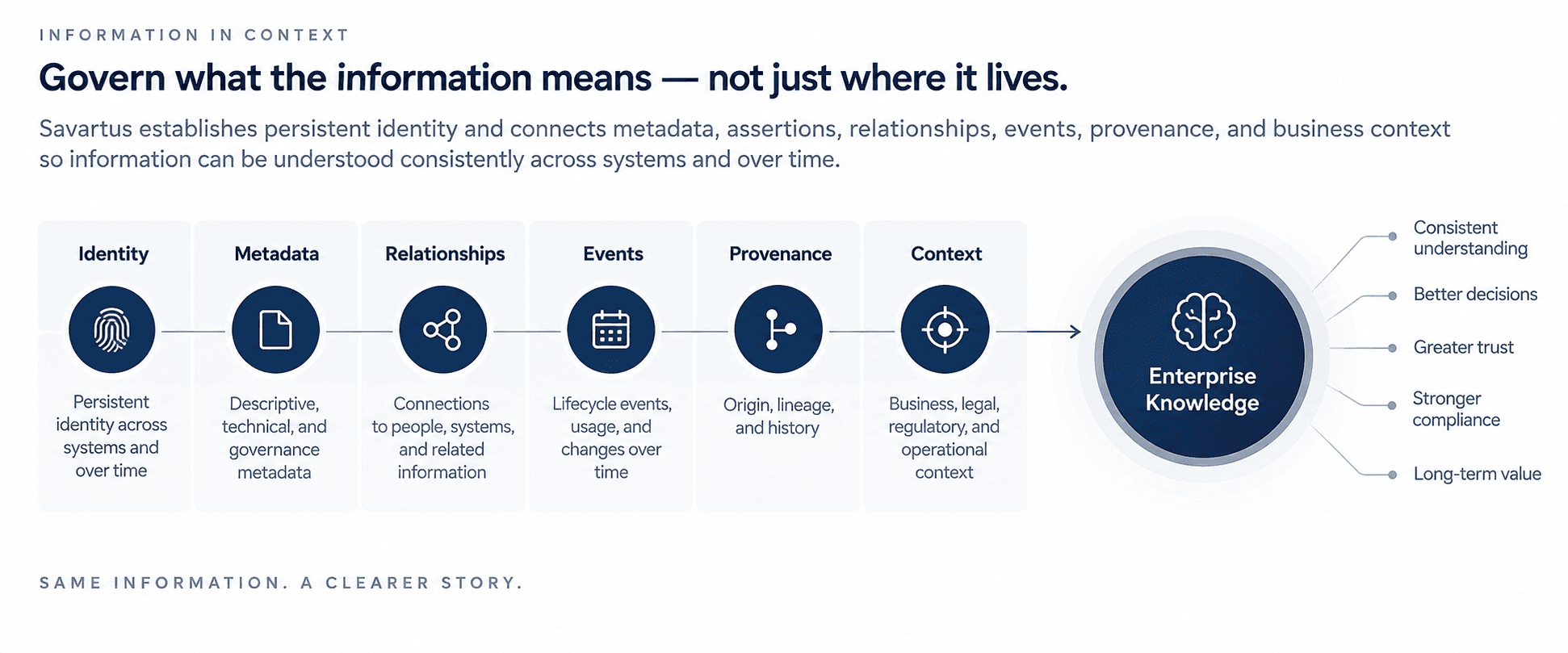
Savartus establishes persistent identity and connects metadata, assertions, relationships, events, provenance, and business context so information can be understood consistently across systems and over time.
POLICY-DRIVEN GOVERNANCE
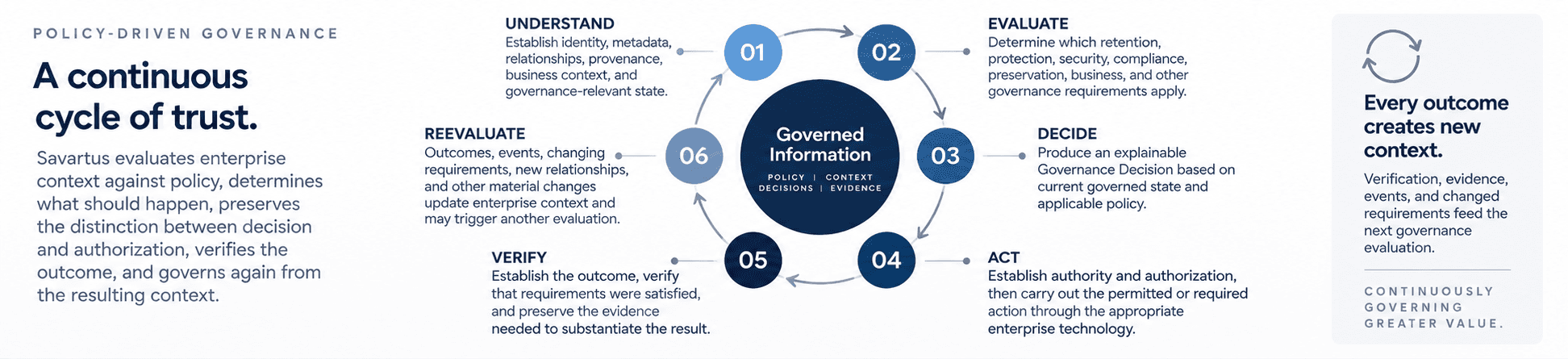
Governance is a continuous cycle. Savartus evaluates enterprise context against policy, determines what should happen, preserves the distinction between decision and authorization, verifies the outcome, and governs again from the resulting context across cloud, NAS, object storage, applications, databases, SSD/HDD, optical, tape, and other repositories.
ENTERPRISE DATA LIFECYCLE™
Lifecycle stages describe the business and governance state of information. They do not define the storage technology that holds it.
Information has been created and enters enterprise context.
Information is actively used in business operations.
Information is actively changed by multiple users or systems.
Information remains operationally valuable while governance becomes increasingly important.
Protection requirements become a defining part of the information's governed state.
Information is retained primarily for historical, evidentiary, analytical, or governance value.
Long-term integrity, authenticity, context, and usability become primary requirements.
Policy conditions permit disposition, subject to authority and authorization.
Authorized disposition has been completed and appropriately evidenced.
Lifecycle transitions may move forward or backward as information requirements change. The appropriate transition is determined by policy and governed context — not merely by elapsed time.
A CRITICAL DISTINCTION
An information object can remain in the same lifecycle state while its storage placement changes — or change lifecycle state without requiring a storage migration.

PRACTICAL EXAMPLE
A dataset may remain in an Archived lifecycle state while moving from low-cost storage back to a high-performance tier because a new analytics or AI workload requires it.
Its storage changed. Its lifecycle state did not.
ENTERPRISE DATA LIFECYCLE™ SPECIFICATION
Savartus Data Lifecycle Management is based on the architectural principles defined by the Enterprise Data Lifecycle™ Specification: persistent information identity, governed state, policy-driven decisions, authorized action, verification, evidence, and continuous reevaluation.
DATA LIFECYCLE MANAGEMENT
Understand what information is, what it means, and what it requires. Then coordinate the appropriate action across enterprise systems, including Active Archive or Preservation when those are the right storage strategies.